Social Entrepreneurship is the process of pursuing innovative solutions by adopting appropriate business model to solve social problems. More specifically, social entrepreneurs adopt a mission to create and sustain social value. Entrepreneurship is a creative human act involving the mobilization of resources from one level of productive use to a higher level of use. "It is the process by which the individual pursue opportunities without regard to resources currently controlled."
Entrepreneurship involves a willingness to take responsibility and ability to put mind to a task and see it through from inception to completion. Another ingredient of Entrepreneurship is sensing opportunities, while others see chaos, contradiction, and confusion. Essence of Entrepreneurship is going against time with maturity and serving as a change agent.
Alliance will draw upon appropriate thinking in both the business and nonprofit worlds and operate in a variety of organizations large and small; new and old; religious and secular; nonprofit, for-profit, and hybrid. We will develop a business model, acquires the human and other required resources, and is fully responsible for its success or failure.
Social Entrepreneurship development in current circumstances has been prime need of country since the pressure on cities are increasing due to mobilization of people towards cities in search of livelihood is the major reason. If alliance gets successful in developing Entrepreneurship in their native places, the problem of this mobilization will be automatically solved. The aims of development of social Entrepreneurship are:
The scope of Entrepreneurship development in India is tremendous. The rising unemployment rate in India has resulted in growing frustration among the youth. In addition there is always problem of underemployment. As a result, increasing the entrepreneurial activities in the country is the only solace. We have all the requisite technical and knowledge base to take up the entrepreneurial challenge. The only thing that is lacking is confidence and mental preparation. We are more of a reactive kind of a people. We need to get out of this and become more proactive. What is more important than the skill and knowledge base is the courage to take the plunge. Our problem is we do not stretch ourselves. However, it is appreciative that the current generations of youth do not have hang-ups about the previous legacy and are willing to experiment. These are the people who will bring about Entrepreneurship in India.
In India, where over 300 million people are living below the poverty line, it is simply impossible for any government to provide means of livelihood to everyone. Such situations surely demand for a continuous effort from the society, where the people are encouraged to come up with their entrepreneurial initiative. Indians are hard workers and creative but they need promotion and favorable environment for entrepreneurial activities.
In the future, innovation and Entrepreneurship needs to be encouraged at Social levels, Governmental levels and Managerial levels. There must be a social attitude that views innovations with positive attitude and reject an innovation only when it is not acceptable. Alliance will make positive environment to promote ENTREPRENEURSHIP through its various promotional programmes launched with collective efforts of member NGOs. Alliance will also conduct seminars and lectures among the entrepreneurs to provide the latest trend of market which will also motivate them to develop new approaches.
At this level the encouragement will refer to two aspects necessary for Entrepreneurship to thrive, one is the provision of venture capital and the other being infrastructural support. Entrepreneurship as in the past will determine technical innovations, status of social institutions and political management systems. On the basis of these factors, we can expect the future to be a place where basic needs will remain and only the wants will change. India will overcome the barriers of infrastructure; we will also visualize a strong manufacturing and agricultural sector.
There are ample opportunities in small businesses in India and such opportunities will transform India in the coming future. For such transformation to happen there needs to be support both at the governmental and societal level. For the government it is important to realize that the goal of small business owners will be to remain self-employed. Such people may not need financial assistance but they will need marketing and legal assistance in order to sustain themselves. Practical and cost effective programs need to be developed to address their needs because self-employed people will represent an important segment in economic revitalization. Entrepreneurship development is the key factor to fight against unemployment, poverty and to prepare ourselves for globalization in order to achieve overall Indian economic progress.
Stake holders refer the participants in social Entrepreneurship development involved with their direct activity and responsibilities. There are five important stake holders who play their crucial role and function as the pillars of social Entrepreneurship:
The entire member NGOs will play very crucial role in Entrepreneurship development being premier/associate member of alliance. They are placed on central point of SEFI. The role of NGOs will be crucial in social enterprise framing and making it successful because of their attachment with society, better understanding of local conditions and needs.
Villagers and under privileged people are important stake holders of SEFI and are highly benefited. They will involve either as Self Help Group or as individual. The role of RUP in the development of social enterprise is important because these people will associate with the Social enterprise is not only with their labour activity but also provide basic infrastructure to access the task.
Private Enterprises and Corporate Sectors will play the role of Social enterprises formation and infrastructure development. Private sectors will take it as opportunities if they are associating with SEFI because they are getting new environment and new business where man powers basic infrastructure and innovative idea is present. As for as corporate areas are concerned, they need new market opportunity and the can involve through CSR activities.
Innovative Professionals like Scientist, Technicians, CA, Marketing Experts etc. and Technical institutions are having very important role in Entrepreneurship development process. Alliance will invite innovators to give ground to their new ideas and get associated with our SEFI in win-win relations. Similarly technical institutions will also be associated to win-win relations. The term and conditions of associations will be decided by SEFI members.
Govt. institutions associate with the development of cottage industries, small scale industries are important stake holders like SIDBI, Khadi Gramodyog, Handicraft, Handloom etc.
a. Primary Stage: In primary stage all the NGOs interested to become part of Social Entrepreneurship Development (SED) Programme will be given some programme to perform and prove itself. There will be grading system for the success and failure for the SED.
b. Secondary Stage: If NGOs qualify in first stage they have to select any one of the Entrepreneurship programme recommended by NANDI and have to produce complete project accordingly and working basic infrastructure meeting the requirement of the project.
Enterprise Development Procedure involves some basic steps: 1. Partnership Development 2. Selection of Business
3. Project Location 4. Project Development | 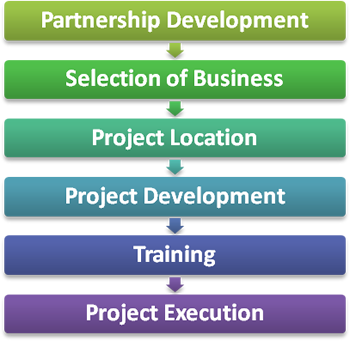 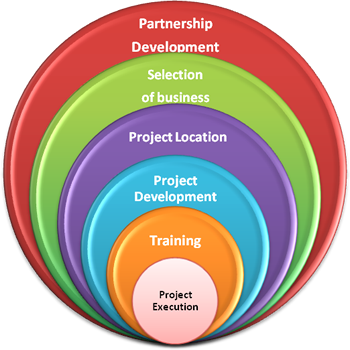 |
5. Training
Once project has been developed SEFI need skill development training for its executives, workers and responsible people going to execute the project. The role of training is crucial since it will be fundamental requirement to have skilled employee to produce quality products.
6. Project Execution
Project execution is a complex process which passes through many sub-steps. Before starting any enterprises a pilot project is necessary to assess the response and after getting favorable result final action should be started.
In India the rural dwellers, which constitute more than 70 per cent of India’s population are facing the acute problems of unemployment and under-employment. To stress the importance of the development of the rural areas and people who inhabited therein, he said, “Swaraj has no meaning for the millions if they do not know how to employ their enforced idleness. Gandhiji said that, “The economic development is meaningful if aimed at the lifting up of the small peasant and converting the small producer himself into an active participant in productive activity. Therefore, he said that the objective of real development means the development of the rural people.
The Industrial Village principally depends on rural production for their raw material and on the rural population for marketing their products. The process has certain essential conditions. The scope of rural industrialization is considered basically a question of properly utilizing the rich but unexploited national resources in the rural areas. It is a process concerned with the involvement of industries in the development of an area and also participation by rural entrepreneurs in the growth of industries best suited to that specific area. The process of rural industrialization, however, is distinguished from the situation under which certain industries are transplanted in a specific rural area. Rural industrialization term connotes that its sole objective should be uplifting of the rural lot by tapping vast material and human resources existing in the countryside. The process of rural industrialization should have its own features such as low investment of capital, labour intensity and use of simple technology by employing local human and material resources. Thus, a judicious mix of local manpower with the local resource is necessary to bring about a viable development in these areas.
The rural industries provide immediate large scale employment and they also offer a method of ensuring a more equitable distribution of national income.
Therefore, the development of Industrial Village was, thus, seen as a way of serving the following objectives:
Alliance is going to select some villages to develop them as Industrial Village. These villages will be called as NANDI Village. Alliance will industrialize this village by providing them basic support such as skill development, development of social enterprises, technical support, financial support and development of required infrastructure. Every NANDI Village will have NANDI Village Entrepreneurship Development Committee. This Committee will be framed by Gram Pradhan, NGOs, Private Sector and local people.